
Understanding Utah’s ESP Transition Bill
A Public Summary by the Utah Home-education Organizations for Parental Empowerment Coalition (UHOPE)

Executive Summary / Overview
A new draft bill—the Open Educational Service Provider Program Transition Act—proposes ending the district–ESP model used by OpenEd, HarmonyEd, and similar programs.
UHOPE remains neutral on this bill. We have reviewed the text carefully, and this summary is intended to help families understand why the bill was introduced, what changes it makes, and how it may affect them. Our purpose here is purely informational.
The creation of this bill follows a formal legislative audit that identified significant issues in how public funds were distributed. When systemic problems surface, legislative leadership is required to act, and the overall direction is usually decided before the public sees a draft.
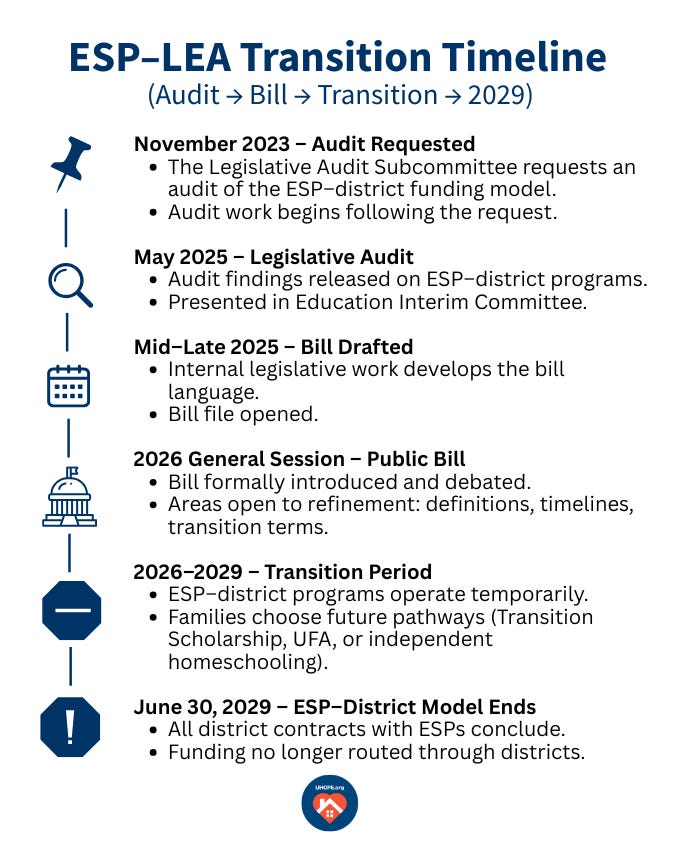
The bill shifts Utah from a multi-layer funding system to a more direct model in which money flows through Utah Fits All (UFA) to families. District contracts with Educational Service Providers (ESPs) would end by June 30, 2029, though families may remain in their programs through 2028–29. After that, families must choose public school, independent homeschooling, or UFA through a new Vendor Transition Scholarship.
Legislators believe the change still gives families influence. They recognize that this shift will be extremely difficult for the roughly 15,000 families who rely on ESPs. Yet they believe families will gain meaningful purchasing power—the ability to choose and fund the services they value. By organizing, communicating clearly with their ESP, and directing scholarship funds toward the supports they want preserved, families can help their programs evolve rather than disappear. UHOPE remains neutral and committed to informing, supporting, and protecting home education in Utah.
For clarity, here is the bill and audit report:
Bill File No. 00004312 — Open Educational Service Provider Program Transition Act:
https://le.utah.gov/interim/2025/pdf/00004312.pdf
Audit Report: Performance Audit of the OpenEd Program (May 2025)
Introduction
This bill aims to address concerns with public-private partnerships (PPPs), in which a public school district contracts with an outside provider to deliver instruction to students learning at home. These arrangements have allowed districts and ESPs to retain substantial public funds connected to homeschooling families. According to legislative leaders, this change is intended to streamline funding so that more of it reaches homeschooling and private-schooling families, rather than districts or intermediaries.
It is important to know this bill did not appear suddenly. It is the result of deliberation, legislative review, and a formal audit requested in the 2024–2025 session, with findings presented in the May 2025 Education Interim Committee meeting. When audits reveal systemic problems in the distribution or oversight of public dollars, the Legislature is obligated to respond. Leadership, fiscal analysts, and legal counsel refined the proposed solution internally; by the time a draft is public, the structural direction is settled. In this case, leadership from both houses has unified around ending the district–ESP model.
Current Law and Its Change
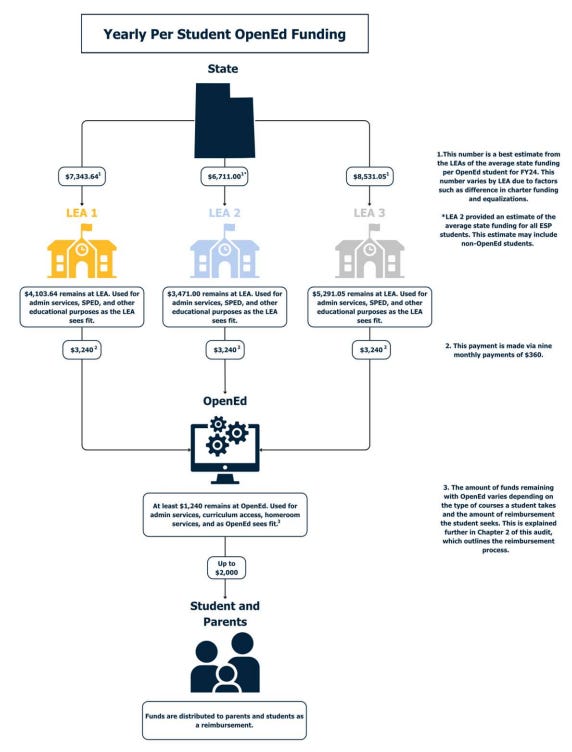
Under current law, taxpayer money becomes student money, which flows to a school district, then to a Local Education Agency (LEA), then to an ESP, and finally to the student.
Current funds flow:
Taxpayer →State Coffers→School District→LEA→ ESP→ Student
Under the new bill, taxpayer money still becomes student money, but flows through UFA directly to the student.
New flow:
Taxpayer →State Coffers→ UFA → Student
(ESA = Educational Scholarship Account)
What Changes
The bill ends all district contracts with ESPs by June 30, 2029. Currently:
Parents sign up with an ESP.
The ESP assigns the student to a partnering school district (LEA)
The district collects public-education funds and passes a portion to the ESP.
This structure will no longer be permitted after the transition period.
Key Provisions and Analysis
Impact on the Public and Community
According to the bill’s sponsors, this change is intended to move Utah toward greater educational freedom for families who choose to educate at home using taxpayer-supported scholarships. Supporters of the bill view the shift toward UFA and direct scholarships as a more efficient, transparent use of funds that strengthens the role of families in directing their children’s education. UHOPE remains neutral and is sharing these points to explain why representatives felt the bill was needed, not to express agreement or endorsement.
Evidence and Reasoning
Updated funding data shows each Utah public-school student receives about $9,000. For ESP students, that amount is divided among districts (retaining $3,471–$5,291), ESPs (retaining at least $1,251), and students (receiving up to $2,000). Because public-education dollars require public oversight, ESPs—even when operating at home—are legally public-school programs, not homeschooling.
Once UFA created a formal pathway for state-funded home-based education, legislators viewed it as inconsistent to maintain a parallel model with lighter oversight. Regardless of past debates, UFA is now part of Utah law, and the transition is being built around the system now in place.
What This Means for Utah Families
This bill clarifies who is an independent homeschooler, removes the gray area around ESP students, and clearly defines who is a scholarship student.
Families using an ESP may remain through the 2028–29 school year. After that, families must choose:
Public school
Independent homeschooling (no state funding, no oversight)
UFA through a Vendor Transition Scholarship
At this stage, families gain real purchasing power—directing UFA funds to providers they choose. This gives parents meaningful leverage. If families want an ESP to continue offering the same resources and support, they can coordinate, communicate, and even allocate a larger share of scholarship funds to sustain the services they value.
For the general public, this reduces waste, increases confidence in the stewardship of taxpayer dollars, and clarifies distinctions between independent homeschoolers and scholarship students. It also expands funding options in a state that values educational flexibility.
How Families Can Engage
For families who value what their ESP offers—such as technology access, a Personal Support Team, or academic support—the key to keeping those benefits is purchasing power. Families can work together to express their expectations to their ESP. Providers will respond because families choose where their funds go.
Parents can, but do not need to, lobby Capitol Hill to preserve their model. Their ability to choose, stay, or move on ultimately shapes what vendors offer. In this case, using purchasing power is far more effective than testifying against the bill.
UHOPE’s Position and Rationale
UHOPE remains neutral—not from inaction, but because this legislation does not alter independent homeschool rights. At the same time, we recognize that families using ESP programs experience this change as a loss of freedom in practice, even if not in statute.
Still, UHOPE must operate from its core objectives: preserving legal rights, coordinating statewide efforts, offering guidance, and protecting the long-term stability of home-based education.
From a policy perspective, taxpayers have a right to transparency, and the bill draws a clear line between public-school programs and independent homeschooling. It also strengthens family leverage under UFA. This is not the end of ESP-style services—it is a change in how families access them.
Looking Forward
According to the bill’s sponsors, this transition is intended to expand family control over how taxpayer-funded educational dollars are used. They have stated that the goal is to simplify a confusing system, reduce waste, and clarify distinctions in law.
We know this change feels heavy. Many families will be frustrated or angry. But as UFA matures, legislators believe families will gain flexibility, more options, and increased influence. UHOPE is sharing these statements to explain why representatives felt the bill was needed, not to signal agreement or disagreement. Our commitment remains the same: to preserve, protect, and promote home education in Utah, and to help families navigate changes and thrive regardless of the path they choose.
Contact Information / Resources
UHOPE.org, uhopecoalition@gmail.com
Bill File No. 00004312 — Open Educational Service Provider Program Transition Act
https://le.utah.gov/interim/2025/pdf/00004312.pdf